
The Future of Adult Education in Europe
The future of Europe will depend not only on technological innovation, economic growth or environmental sustainability, but also on its
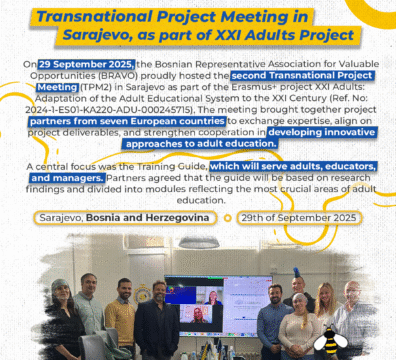
Transnational Project Meeting in Sarajevo as part of XXI Adults project
On 29 September 2025, the Bosnian Representative Association for Valuable Opportunities (BRAVO) proudly hosted the second Transnational Project Meeting (TPM2) in Sarajevo as part of the Erasmus+ project XXI Adults: Adaptation of the Adult Educational System to the XXI Century
Who Cares for the Caregivers? Making Learning Possible for Adults with Caring Responsibilities
An adult who wants to join a course may first need to answer a practical question: who will take care of the person who depends on them while they study?
Beyond the City: Bringing Adult Learning to Rural Communities
For an adult living in a rural community, joining a course can involve much more than choosing a subject. It may require a long journey, arranging transport, finding someone to take over caring responsibilities, or travelling home after public transport has stopped running.
Innovative Teaching Methods for Adult Educators
Adult education has changed significantly over the past few decades. While the goals of education, developing knowledge, skills and confidence,
Building European Citizenship Through Adult Education
European citizenship is often associated with freedom of movement, shared institutions and common values. Yet these principles become meaningful only
Accessible by Design: Making Adult Learning Work for People with Disabilities
An adult may be ready to learn, interested in a course, and confident about their goals, yet still face barriers to participation. The registration form might be difficult to navigate with assistive technology. A video might have no captions. A classroom might be physically inaccessible, or the learning materials might be difficult to read.
How Technology Is Transforming Adult Learning
Technology has changed almost every aspect of modern life, and education is no exception. Over the past two decades, digital
Adult Education and Social Inclusion: Creating Opportunities That Leave No One Behind
Education has always been recognised as one of the most powerful tools for personal development. Yet its true value extends
Lifelong Learning: Why Learning Should Never Stop
Education has long been associated with childhood, adolescence and early adulthood. Yet in a world shaped by rapid technological change,

Online check-in Meeting of “XXIAdults” Project
The latest online meeting of the XXI ADULTS Erasmus+ project, held on May 6th, 2025, marked another important step forward. With representatives from Bosnia and Herzegovina, Spain, Greece, Poland, and Portugal, the consortium came together to review progress, align on upcoming tasks, and reinforce its commitment to building a more digitally inclusive educational future for adults.
Digital Skills Are the New Literacy
Only a generation ago, being literate meant being able to read, write and perform basic arithmetic. These skills formed the
Why Adult Education Must Change for the 21st Century
There was a time when education followed a relatively predictable path. People completed school, perhaps continued to university or vocational

Kick-Off Meeting in Valladolid: Shaping the Future of Adult Education with XXIAdults
On April 3rd, 2025, the XXIAdults project launched with its kick-off meeting held in Valladolid, Spain, at the premises of the coordinating organisation, Diputación de Valladolid. With clear roles, strong communication, and shared enthusiasm, the XXIAdults consortium is well-positioned to drive meaningful change in adult education.
Learning Together Across Generations: When Everyone Becomes a Teacher
An adult learning group can bring together people whose lives have been shaped by different technologies, workplaces, and social experiences. Some participants may be starting their careers, while others bring decades of professional and community
experience.
Small Steps, Real Progress: Microlearning for Busy Adults
For many adults, the desire to learn is easier to find than the time to do it. Work, family responsibilities, appointments, and everyday tasks can leave little room for a regular
study routine.
Recognising What Adults Already Know: The Value of Prior Learning
A person entering an adult education programme brings more than their previous school certificates. They also bring years of experience: solving problems at work, managing responsibilities at home, supporting others, and adapting to changing circumstances.
Learning Without Fear: Helping Adults Overcome the Anxiety of Returning to Education
Returning to education as an adult can be an exciting opportunity. It can open doors to new skills, greater independence, and personal growth. Yet, for many people, the decision to start learning again comes with uncertainty.
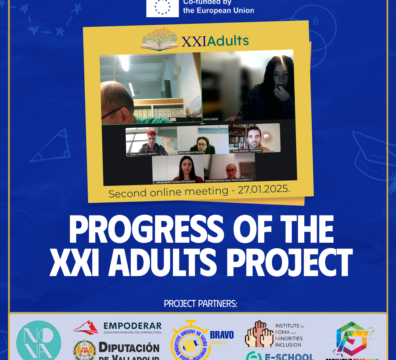
XXI Adults – Second Online Meeting
At BRAVO, we are proud to be at the forefront of this transformation through the Erasmus+ project, XXI Adults. In collaboration with our partners, we are working to modernize teaching methods, close the digital divide, and expand opportunities for lifelong learning.