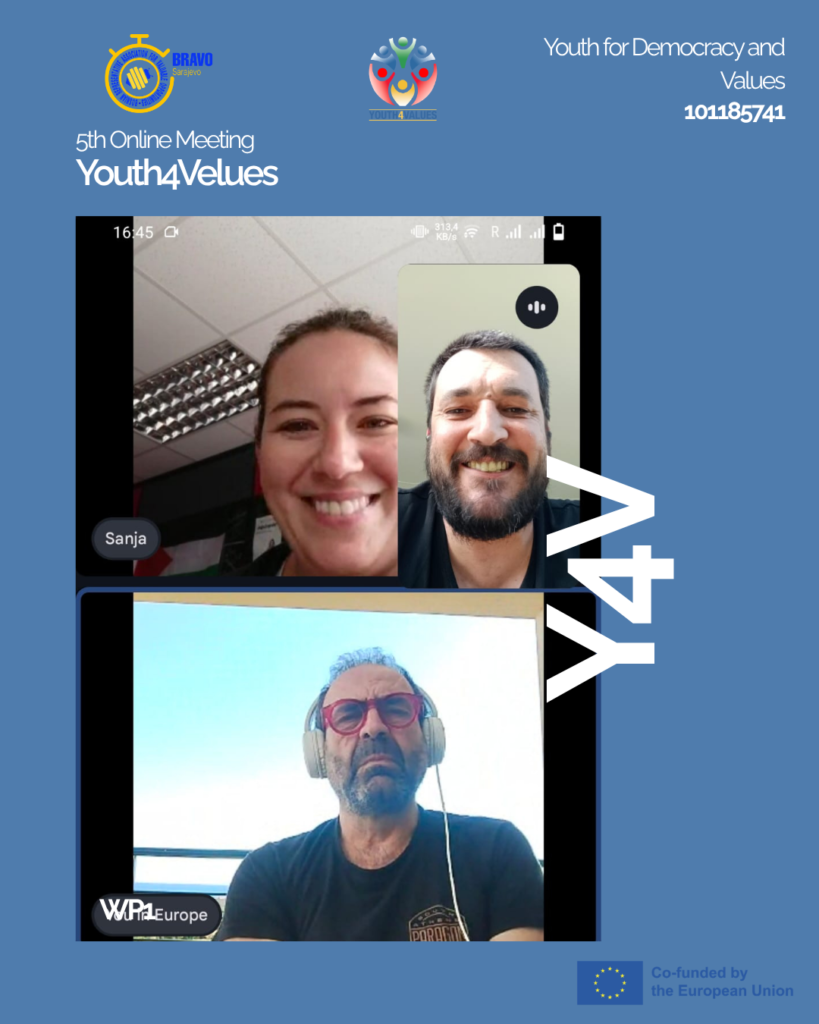
The fifth international meeting was dedicated to comparing concrete participation mechanisms used in the four partner countries. National groups presented examples of youth councils, local forums, volunteering schemes, civic education activities, petitions, advisory bodies and cooperation between young people and public institutions.
Participants evaluated these examples by asking several practical questions: Who is able to participate? How are young people selected or invited? Do decision-makers attend? Is there a formal obligation to respond? Are the outcomes published? Can young people see what changed after their involvement? This analysis helped distinguish meaningful participation from activities that provide visibility without real influence.
The meeting identified several elements of good practice. Successful mechanisms usually have a clear mandate, regular meetings, accessible communication, diverse membership and direct contact with responsible institutions
They also provide feedback and allow young people to follow the progress of their proposals. Participants noted that youth structures are more credible when they are connected with schools, universities, municipalities, civil society organisations and informal youth groups rather than operating in isolation.
The groups also discussed how volunteering and community initiatives can serve as entry points into active citizenship. For many young people, participation begins with solving a local problem, supporting a social cause or organising an activity, rather than joining a formal political structure. The National Action Plans should therefore recognise different paths to engagement and support young people as they move from local action towards policy dialogue.
The exchange gave every national team practical models that could be adapted to its own context. More importantly, it encouraged participants to assess not only whether a structure exists, but whether it gives young people a genuine voice, appropriate support and a realistic possibility to influence decisions.
ABOUT THE PROJECT
The Youth4Values – Youth for Democracy and Values project was created to support young people in becoming more active, informed, and engaged citizens in their local communities. The project focused on strengthening democratic values, active citizenship, youth participation, human rights, inclusion, and the connection between young people and decision-making processes.
In many European communities, young people still do not have enough space to express their opinions, participate in public life, or influence decisions that affect their everyday lives. This is especially visible among young people with fewer opportunities, who often face additional barriers such as limited access to information, lack of support, social exclusion, economic difficulties, or low trust in institutions.
Youth4Values responded to these needs by creating practical opportunities for young people to learn, discuss, act, and connect. The project did not focus only on theory. It encouraged young people to understand democracy through real experiences, local engagement, peer learning, dialogue, workshops, campaigns, and direct participation in community activities.
The project was implemented by partners from Bosnia and Herzegovina, Greece, Montenegro, and Spain, bringing together different realities, experiences, and approaches to youth participation. This international cooperation helped partners exchange good practices, compare challenges in their countries, and develop local activities that were adapted to the real needs of young people in each community.
A strong part of the project was its focus on non-formal education. Through interactive activities, participants had the opportunity to develop critical thinking, communication, teamwork, civic awareness, and a better understanding of their rights and responsibilities as citizens. The project also promoted the importance of youth organisations as spaces where young people can practice democracy, build confidence, and take active roles in society.
According to the project application, Youth4Values aimed to enhance democratic governance and the rule of law by promoting civic education, active citizenship, and youth empowerment. It also focused on connecting democracy with human rights, inclusion, and meaningful participation in decision-making processes.