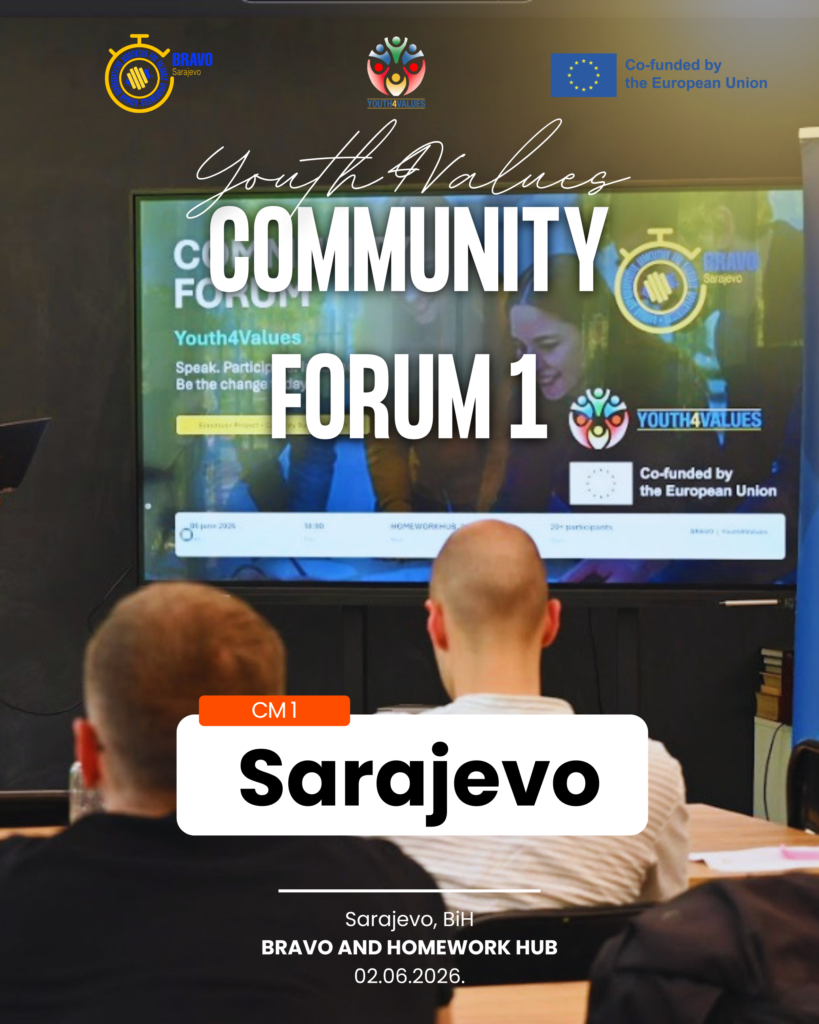
On 2nd June 2026, Homework Hub in Sarajevo became a vibrant space for dialogue, collaboration, and civic engagement as young people, community members, civil society organizations, business representatives, and local stakeholders gathered for a Community Forum focused on shaping the future of their communities.
The event was designed to demonstrate how local democracy works in practice and to encourage citizens to take an active role in decision-making processes that directly affect their daily lives. Through interactive discussions and simulation exercises, participants explored real community challenges and worked together to identify practical solutions.
Community forums are much more than meetings. They create opportunities for people from different backgrounds to come together, exchange ideas, and build a shared understanding of local issues. By encouraging open dialogue and mutual respect, these forums help ensure that diverse voices are heard and valued.
Throughout the day, participants engaged in a structured forum process that mirrored real-life local governance practices. They discussed issues relevant to their communities, analyzed root causes, and proposed actions that could contribute to positive change. The simulations allowed participants to experience how democratic participation can influence decision-making and improve the quality of local governance.
A special focus was placed on youth engagement. Young participants were encouraged to express their opinions, contribute ideas, and take on active roles within the discussions. Their perspectives highlighted the importance of creating inclusive spaces where future generations can participate in shaping their communities and developing solutions to local challenges.
The Community Forum also served as an important learning opportunity. Participants strengthened their understanding of participatory governance and developed practical skills that can be applied in their everyday civic activities. These included community-building, collaborative problem-solving, communication, consensus-building, and active citizenship.
By bringing together citizens, civil society organizations, local institutions, and representatives of the business sector, the forum demonstrated how cooperation can lead to more transparent, accountable, and responsive local governance. Such initiatives contribute to building trust between citizens and institutions while promoting a culture of participation and shared responsibility.
The event reaffirmed that meaningful change begins when people are given the opportunity to engage, listen, and work together. As participants left Homework Hub, they carried with them not only new knowledge and skills but also a stronger belief that their voices matter and that they have the power to contribute to the development of their communities.
Community forums continue to play a vital role in strengthening local democracy by creating spaces where citizens can actively participate in shaping decisions, improving transparency, and fostering inclusive community development. Through dialogue, collaboration, and collective action, communities become stronger, more resilient, and better prepared to address the challenges of the future.
ABOUT THE PROJECT
The Youth4Values – Youth for Democracy and Values project was created to support young people in becoming more active, informed, and engaged citizens in their local communities. The project focused on strengthening democratic values, active citizenship, youth participation, human rights, inclusion, and the connection between young people and decision-making processes.
In many European communities, young people still do not have enough space to express their opinions, participate in public life, or influence decisions that affect their everyday lives. This is especially visible among young people with fewer opportunities, who often face additional barriers such as limited access to information, lack of support, social exclusion, economic difficulties, or low trust in institutions.
Youth4Values responded to these needs by creating practical opportunities for young people to learn, discuss, act, and connect. The project did not focus only on theory. It encouraged young people to understand democracy through real experiences, local engagement, peer learning, dialogue, workshops, campaigns, and direct participation in community activities.
The project was implemented by partners from Bosnia and Herzegovina, Greece, Montenegro, and Spain, bringing together different realities, experiences, and approaches to youth participation. This international cooperation helped partners exchange good practices, compare challenges in their countries, and develop local activities that were adapted to the real needs of young people in each community.
A strong part of the project was its focus on non-formal education. Through interactive activities, participants had the opportunity to develop critical thinking, communication, teamwork, civic awareness, and a better understanding of their rights and responsibilities as citizens. The project also promoted the importance of youth organisations as spaces where young people can practice democracy, build confidence, and take active roles in society.
According to the project application, Youth4Values aimed to enhance democratic governance and the rule of law by promoting civic education, active citizenship, and youth empowerment. It also focused on connecting democracy with human rights, inclusion, and meaningful participation in decision-making processes.