It starts small. Someone makes a comment that seems like a joke. Then another person shares something “edgier.”
Before long, a thread that started with humor has turned into something genuinely hateful – directed at a specific group of people because of their ethnicity, religion, sexual orientation, or gender.
Maybe you’ve seen this happen. Maybe you’ve witnessed someone being targeted. Or maybe you’re worried about your own safety when you speak up online.
The scale of the problem
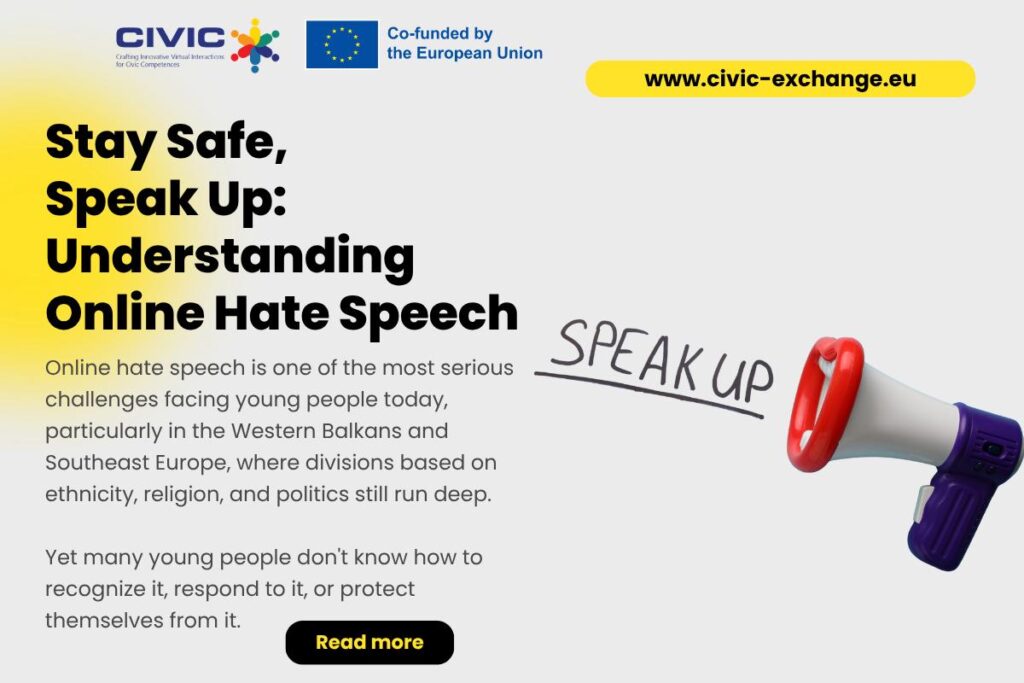
Online hate speech is one of the most serious challenges facing young people today, particularly in the Western Balkans and Southeast Europe, where divisions based on ethnicity, religion, and politics still run deep. Yet many young people don’t know how to recognize it, respond to it, or protect themselves from it.
The numbers are concerning. Recent studies show that roughly 80 percent of young people in Greece have encountered hateful content online but don’t know how to identify it. Similar patterns appear across the region. Young people are being exposed to hate speech regularly – on social media platforms, in comment sections, in group chats – but they often lack the tools to understand what they’re seeing and how to respond.
❝ What makes this worse is that online hate speech doesn’t stay online.❞
It can inspire real-world discrimination and violence. Marginalized communities – whether they’re migrants, religious minorities, LGBTQ+ individuals, or people from different ethnic backgrounds – are particularly vulnerable. For them, online hate isn’t just offensive; it can feel like a genuine threat.
What counts as hate speech, anyway?
This is actually a more complicated question than it seems. There’s a difference between:
- Expressing a political opinion you disagree with
- Making an insensitive joke (even if it’s in poor taste)
- Deliberately targeting a group of people with dehumanizing language intended to harass or intimidate them
Hate speech, specifically, involves language that attacks people based on who they are – their identity – rather than what they do or believe. It often includes:
- Slurs or dehumanizing language designed to demean an entire group;
- Stereotypes or generalizations that paint a group as dangerous, inferior, or untrustworthy;
- Calls for violence or exclusion targeting people because of their identity; or conspiracy theories that blame particular groups for societal problems.
The tricky part is that hate speech can be explicit and obvious, or it can be coded and subtle. Sometimes it hides behind irony or “just asking questions.” Learning to recognize it – especially in its more disguised forms – is part of becoming digitally literate.
Why it matters more than you think
You might wonder: isn’t free speech important? Can’t people just say what they want online? Yes and no. Free speech is a crucial right, but it comes with responsibility. When speech is designed primarily to dehumanize, harass, or incite violence against a group of people, it actually undermines the ability of those people to participate freely in society. It silences them.
❝ Think about it this way: if you belong to a group that’s regularly attacked online, you might stop posting, stop sharing your opinions, or stop engaging in online spaces altogether – not because you lack courage, but because the harassment makes it unsafe or exhausting.❞
That means hate speech doesn’t just hurt individuals; it damages democracy by reducing diverse voices and perspectives in public conversation. Beyond the philosophical arguments, there are practical consequences. Young people who are regularly exposed to hate speech report higher levels of anxiety and depression. Marginalized youth are particularly affected. And in divided societies, online hate speech can deepen the very divisions that make peace and coexistence more difficult.
How to recognize online hate speech
Learning to spot hate speech means paying attention to both the content and the context. Here are some signs:
- Language that dehumanizes. When people use animal comparisons, disease metaphors, or other language that suggests a group isn’t fully human, that’s a major red flag. Phrases like “they’re infesting our country” or “they breed like rats” are textbook examples.
- Sweeping generalizations. Not all members of any group are the same, but hate speech often treats them as if they are. “All [group] are criminals,” “All [group] are terrorists,” “All [group] are lazy” – these kinds of statements are designed to create prejudice.
- Conspiracy theories targeting specific groups. These often blame a particular ethnic, religious, or political group for major problems – economic decline, crime, cultural decline – in a way that’s disconnected from reality but emotionally powerful.
- “Us versus them” framing that’s hostile. There’s a difference between discussing differences between groups and deliberately creating an enemy image of another group. The latter is more concerning.
- Calls for exclusion or violence. Sometimes hate speech is explicit: “We should kick them out,” “They don’t belong here,” or worse. This is unambiguous hate speech.
- Coded or subtle language. Not all hate speech is obvious. Sometimes people use dog whistles – coded language that regular people might not understand but that signals belonging to a hateful ideology. This is harder to spot but equally harmful.
What you can do
If you encounter online hate speech, you have options:
Report it – Most social media platforms have reporting mechanisms for hate speech. Use them. If enough people report violating content, platforms will remove it. Don’t engage directly with the person spreading hate. Arguing with someone determined to spread hate speech rarely changes their mind and often amplifies the harmful message. It can also put you at risk if the person becomes aggressive.
Support the target – If someone in your online community is being attacked, you can respond by expressing solidarity, amplifying their voice, or simply checking in with them privately.
Call it out, if it’s safe to do so – Sometimes a calm, factual correction can make a difference, especially with people who might not realize what they’re saying is harmful. But assess the situation first – your safety matters.
Create counter-narratives – Share positive content that celebrates diversity, challenges stereotypes, and shows the humanity of groups that are often targeted. This helps balance the harmful narratives.
Stay informed – The more you understand about the history and context of divisions in your region, the better equipped you’ll be to recognize propaganda and misinformation when you see it.
Protect your own safety – If you’re a member of a marginalized group or if you speak up against hate speech online, you might face harassment yourself. Here are ways to protect yourself:
- Use privacy settings to control who can contact you and see your content
- Don’t engage with trolls or people trying to provoke you
- Document harassment (take screenshots) in case you need to report it
- Mute or block people who are harassing you – you don’t owe them engagement
- Talk to people you trust about what you’re experiencing
- Remember that the harassment says something about the person doing it, not about you
Why this conversation needs to happen
Online hate speech thrives in silence and ignorance. When young people don’t understand what it is or how to respond to it, it spreads unchecked. But when we develop critical awareness, when we support each other, and when we actively choose to build more inclusive online communities, we can change the culture.
This is particularly important in the Western Balkans and Southeast Europe, where historical divisions still shape how people relate to each other. Young people have an incredible opportunity to break these patterns – but only if we’re equipped with the knowledge and skills to do so.
Join the conversation
CIVIC is launching online exchange rounds dedicated to understanding online hate speech, digital safety, and how to build more inclusive online spaces. These aren’t lectures – they’re conversations where you’ll hear from peers across Europe, share your own experiences, and learn practical strategies together.
Whether you’ve been targeted by hate speech, worried about how to respond to it, or simply concerned about the state of online discourse, there’s a place for you in these discussions.
Registration opens soon. We hope you’ll join us in building a safer, more respectful digital space for everyone. Because staying safe online and speaking up against hate speech aren’t contradictory – they’re two sides of the same coin.
#BRAVO #BRAVOBIH #MAKETHEWORLDWONDER #ERASMUSPLUS