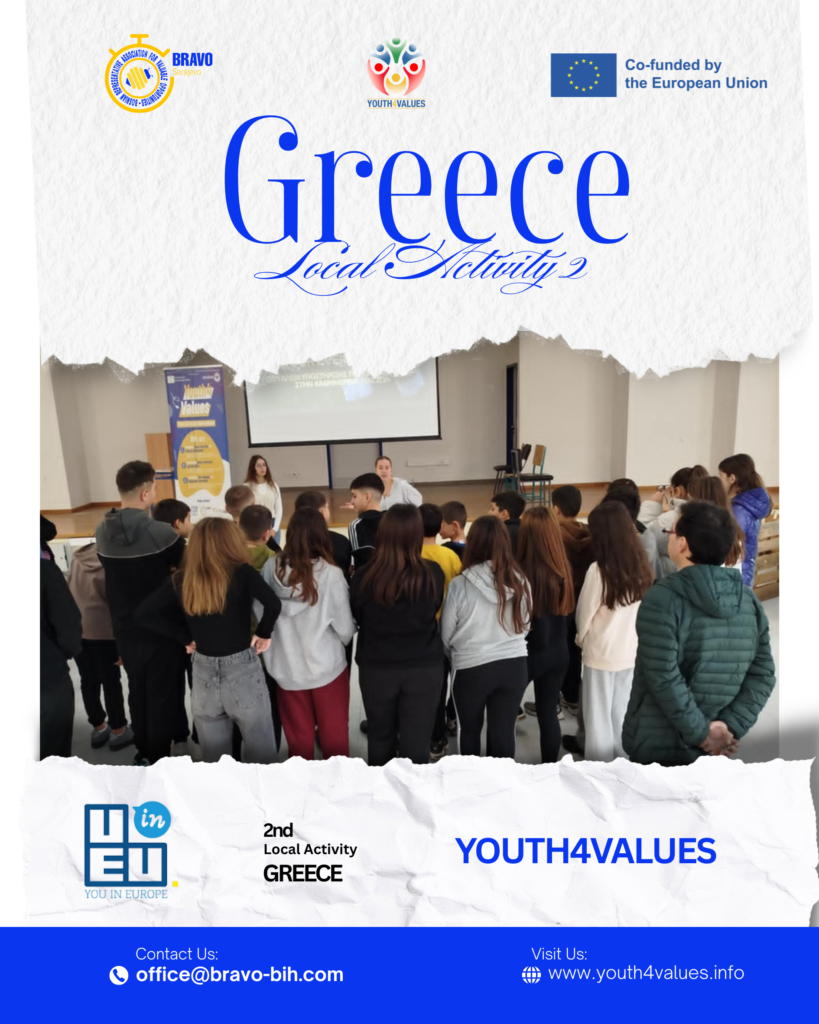
Greece WS 2 – Empowering Active Citizenship: A Youth Workshop at the 2nd Junior High School of Nea Moudania.
Active citizenship is not an abstract concept reserved for policy debates – it is a lived practice that begins at the local level, often within classrooms and communities. A recent workshop held at the 2nd Junior High School of Nea Moudania demonstrated precisely this principle, offering students a structured yet dynamic opportunity to engage with real-world challenges in their city.
The workshop was designed as an interactive learning experience, encouraging students to move beyond passive observation and into active problem-solving. Rather than focusing solely on theoretical knowledge, participants were invited to critically assess their local environment. They identified concrete issues affecting their community and, crucially, worked collaboratively to propose feasible solutions. This methodological approach aligns with contemporary practices in youth work and civic education, where experiential learning and participation are prioritized over traditional didactic instruction.
The guiding motto, “Do what you can to solve the problem,” encapsulated the core message: meaningful change begins with individual and collective initiative. Students were encouraged to understand that civic engagement is not dependent on large-scale institutional intervention but can emerge from localized, incremental actions. This perspective is particularly significant in the context of youth empowerment, as it reframes young people from passive beneficiaries of policy to active contributors to societal development.
Equally important was the role of the school environment in facilitating this engagement. By embedding the workshop within an educational setting, the initiative effectively bridged formal education and civic participation. The involvement of teachers and school leadership, including Principal Mr. Stamatis Stamatiadis, ensured that the activity was not an isolated event but part of a broader pedagogical commitment to fostering critical thinking and social responsibility. The participation of the environmental team further reinforced the relevance of sustainability and community-oriented action, linking local concerns to global challenges.
The outcomes of the workshop extend beyond the immediate exercise of identifying problems and solutions. Students gained practical skills in teamwork, communication, and analytical thinking – competencies that are essential for long-term civic engagement. More importantly, they experienced a shift in perspective: from recognizing problems as external obstacles to viewing them as opportunities for intervention and improvement.
In a broader sense, initiatives such as this workshop contribute to strengthening democratic culture at its foundations. By equipping young individuals with the mindset and tools necessary for active participation, they lay the groundwork for more resilient and responsive communities. The experience of the students in Nea Moudania illustrates that when youth are given the space and support to engage meaningfully, they are not only capable of understanding complex issues but also of contributing constructively to their resolution.
ABOUT THE PROJECT
The Youth4Values – Youth for Democracy and Values project was created to support young people in becoming more active, informed, and engaged citizens in their local communities. The project focused on strengthening democratic values, active citizenship, youth participation, human rights, inclusion, and the connection between young people and decision-making processes.
In many European communities, young people still do not have enough space to express their opinions, participate in public life, or influence decisions that affect their everyday lives. This is especially visible among young people with fewer opportunities, who often face additional barriers such as limited access to information, lack of support, social exclusion, economic difficulties, or low trust in institutions.
Youth4Values responded to these needs by creating practical opportunities for young people to learn, discuss, act, and connect. The project did not focus only on theory. It encouraged young people to understand democracy through real experiences, local engagement, peer learning, dialogue, workshops, campaigns, and direct participation in community activities.
The project was implemented by partners from Bosnia and Herzegovina, Greece, Montenegro, and Spain, bringing together different realities, experiences, and approaches to youth participation. This international cooperation helped partners exchange good practices, compare challenges in their countries, and develop local activities that were adapted to the real needs of young people in each community.
A strong part of the project was its focus on non-formal education. Through interactive activities, participants had the opportunity to develop critical thinking, communication, teamwork, civic awareness, and a better understanding of their rights and responsibilities as citizens. The project also promoted the importance of youth organisations as spaces where young people can practice democracy, build confidence, and take active roles in society.
According to the project application, Youth4Values aimed to enhance democratic governance and the rule of law by promoting civic education, active citizenship, and youth empowerment. It also focused on connecting democracy with human rights, inclusion, and meaningful participation in decision-making processes.