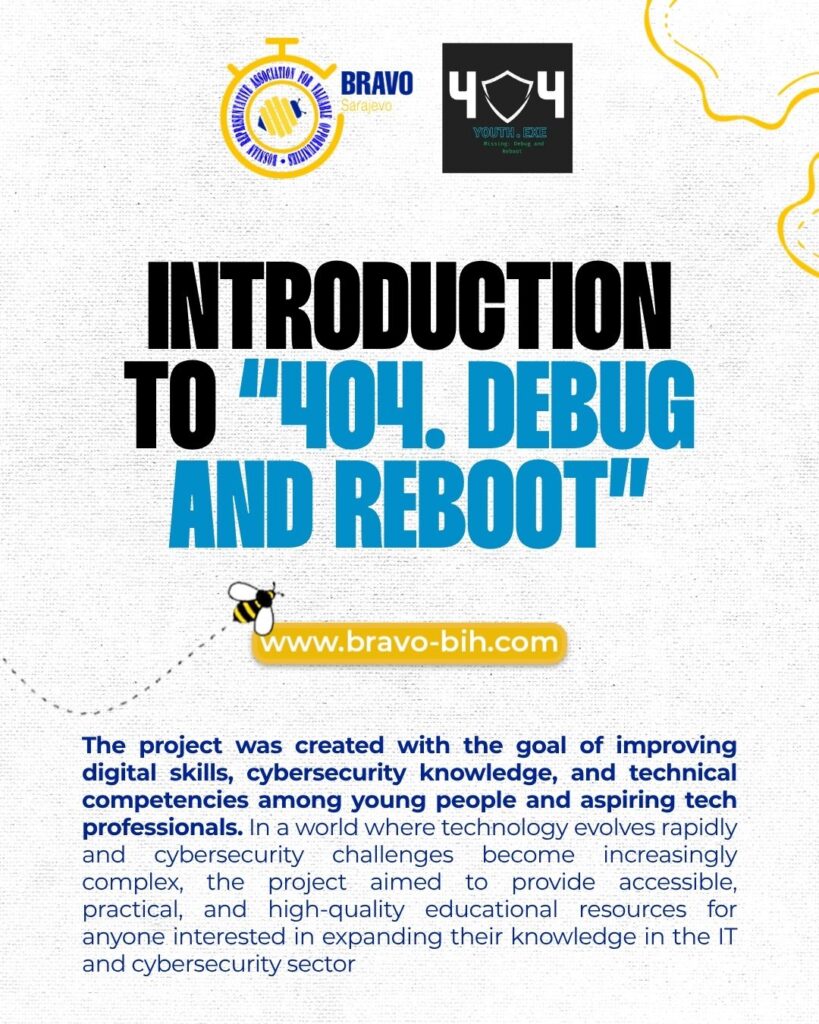
The project “404. Debug and Reboot” was created with the goal of improving digital skills, cybersecurity knowledge, and technical competencies among young people and aspiring tech professionals.
In a world where technology evolves rapidly and cybersecurity challenges become increasingly complex, the project aimed to provide accessible, practical, and high-quality educational resources for anyone interested in expanding their knowledge in the IT and cybersecurity sector.
As part of the project implementation, a series of specialized online courses was developed, covering key areas of reverse engineering, debugging, cybersecurity, secure coding, and technology entrepreneurship.
The courses were designed to combine theoretical foundations with practical approaches, enabling participants to better understand modern technological systems, software analysis, and digital security principles.
The first course, “Introduction to Reverse Engineering: Goals, Ethics, and Legal Boundaries,” introduces participants to the fundamentals of reverse engineering while emphasizing the importance of ethical responsibility and legal considerations in cybersecurity work. Participants gain insight into the purposes, methodologies, and limitations of reverse engineering practices in modern technology environments.
The second course, “Binary Fundamentals: Assembly, Calling Conventions, and Memory Model,” focuses on understanding low-level software structures and system architecture. Through this course, learners explore assembly language, memory management concepts, and binary-level operations that form the basis of software analysis and debugging.
❝ Participants learn how to identify patterns, analyze control flow graphs, and apply heuristic approaches to software inspection and cybersecurity analysis. ❞
The third course, “Static Analysis Techniques: Strings/Imports, CFG Reading, Signatures & Heuristics,” introduces methods used to analyze software without executing it.
The fourth course, “Dynamic Analysis & Instrumentation: Tracing, Hooking, and Sandbox Approach,” focuses on runtime software analysis and monitoring techniques. Learners are introduced to tracing systems, sandbox environments, and instrumentation methods used in malware analysis, software testing, and security research.
The fifth course, “Debugging Mastery: Reproduction, Isolation, Logging, Testing, and Performance Debugging,” provides participants with practical debugging techniques essential for identifying and solving software issues. The course emphasizes systematic problem-solving approaches, testing methodologies, and performance optimization strategies relevant to real-world software development.
❝ Cybersecurity concepts are further explored in the sixth course, Cybersecurity Fundamentals: Threat Modeling, Risk, and Core Defense Principles. ❞
This course introduces participants to the foundations of digital security, including risk assessment, threat analysis, and defense mechanisms used to protect systems, networks, and data from cyber threats.
The seventh course, “Application Security & Secure Coding: OWASP, Vulnerability Classes, and Mitigation,” focuses on secure software development practices and modern application security standards. Participants learn about common vulnerabilities, OWASP principles, mitigation techniques, and the importance of integrating security into the software development lifecycle.
In addition to technical skills, the project also emphasized innovation and entrepreneurship through the eighth course, “Entrepreneurship for Tech Builders: Productization, Pricing, Go-to-Market, Metrics & Pitch.” This course supports young innovators and developers in transforming technical ideas into sustainable products and startups by introducing concepts related to product development, business strategy, marketing, and pitching.
❝ One of the most significant aspects of the “404. Debug and Reboot” project is accessibility. ❞
All courses are available free of charge on the project’s webpage, allowing anyone interested to access the materials, learn at their own pace, and improve their technical and professional competencies regardless of their educational or financial background.
Upon successful completion of the courses, participants receive certificates recognizing their acquired knowledge and engagement. This not only motivates learners to complete the training but also supports their employability and professional development in the rapidly growing technology and cybersecurity sectors.
Through its open-access educational model, “404. Debug and Reboot” contributes to digital inclusion, lifelong learning, and youth empowerment by making advanced technological knowledge accessible to a broader audience. The project demonstrates how innovative educational initiatives can bridge skill gaps, encourage self-development, and prepare individuals for the challenges and opportunities of the modern digital world.
#BRAVO #BRAVOBIH #MAKETHEWORLDWONDER #ERASMUSPLUS